News

Major Prebagaran – A trainer who changes lives

Malaysia has many excellent trainers, but one who truly changes lives is a rare breed. Major Dr. Prebagaran Jayaraman (R) is one of them. Over the past week, I had the opportunity to take part in a training programme Dr Praba conducted Honestly, I wasn’t expecting to be blown away. When you get to my age, you sometimes feel like you’ve seen it all. Then came along Dr Praba. 15 minutes in, his sharing gave me goosebumps. Five days later, I found myself compiling “50 Pearls of Wisdom” by Dr Praba. What struck me most is that he doesn’t teach from theory alone. His life experience reads like several books rolled into one. As military, he has literally put his life on the line for his country. As a leader, he has faced public setbacks and rebuilt himself with resilience. As a family man, he speaks about his wife – whom he has co-written a book with – and his children with deep affection and respect. And as a trainer? I think I speak for my whole group when I say these five days transformed how we think about learning, leadership and even ourselves. Out of respect for Dr Praba’s course content, I won’t share everything. I will highlight a few things that particularly resonated with me: ✅ Be ethical. Respect the source of ideas and give credit where it is due. ✅ Don’t judge others. Everyone has their own strengths and abilities. ✅ Stay humble. No matter how much you know, there is always more to learn. Dr Praba, it has been a privilege learning from you. I have no doubt you will continue to impact many lives in the years ahead. May God bless you. Thanks a million to Yee Zer Ng and Sean Lee, Chew for creating this wonderful learning opportunity for all of us.

Major Prebagaran – A trainer who changes lives Read More »

109 Chinese Car Brands?!

109 CHINESE CAR BRANDS?! WHAT???  When I first saw this chart, I had to double-check it. That’s one hundred and nine carmakers, all in one country! From “Luxury” down to “Low-cost.” (Thank you Reddit.) At first glance, it looks insane. Violates all business school strategy text books. Why would any government or industry allow this kind of fragmentation? Wouldn’t it be more efficient to focus on a few national champions? But that’s the paradox of China’s EV boom. Then again, perhaps it’s genius. “LET A THOUSAND FLOWERS BLOOM” It’s a phrase from old China, but it captures what’s happening now. The government didn’t try to pick winners. It simply let a thousand flowers bloom – allowing ideas, technologies, and business models to compete freely. Some flourished. Many will wither. But through this chaos, China has built the world’s most complete EV ecosystem – from batteries and semiconductors to software, motors, and charging networks. This approach compressed 30 years of industrial learning into a single decade. The results are shaking the world. German automakers – once untouchable in engineering and prestige – now find themselves outpaced in software, cost, and speed. Even Tesla’s cost advantage increasingly depends on its China-based supply chain. This isn’t just a price war. IT’S A CAPABILITY WAR. China’s crazy, chaotic, capitalistic model has produced competitors now storming global markets. WHAT HAPPENS NEXT? Most won’t survive. The pyramid will shrink. But the survivors? They’ll be battle-hardened, globally capable, and export-ready. In China, they call it “involution” (内卷 nèijuǎn) – a term originally describing the contraction of the uterus after childbirth, so the body can grow strong again. Exactly as evolution works in nature – only the best adapt and endure. Those who survive will redefine global automotive economics. LESSONS FOR MALAYSIA AND ASEAN There’s a clear takeaway for us – as Malaysia stands in the spotlight this week. We cannot choose our national champions, no matter how much our leaders might wish to. The market will decide. What governments can and must do is provide the ‘fertiliser’ for the ‘flowers’ to bloom – the policies, incentives, and ecosystem that help good ideas take root, grow, and flourish. Encourage experimentation. Invest in the ecosystem, people, and talent – not just assembly lines. Support batteries, materials, and chip design – the invisible backbone of the EV revolution. This applies not just to Malaysia, but to ASEAN as a whole. Real transformation will always look messy, competitive, and creative in its early stages. When you let a thousand flowers bloom, for sure, not all will survive. But those that do, will change the world. Does Malaysia just want to survive and make money? Or make a real impact within ASEAN? Original Linkedin post here. 

109 Chinese Car Brands?! Read More »

Podcast with Salah Nasri, International Semiconductor Industry Group

Thank you Salah Nasri for organizing this podcast! Photo: Ellen Wendelin Loh, ET Tan & Salah Nasri What makes a risky tech bet pay off? Here’s the formula. In this Semiconductor Leadership Podcast episode, ET Tan — former HP & Seagate Technology leader and a pioneer in R&D — breaks down the difference between bold innovation and costly missteps: Start with insight — deeply understand the real market need. Engineer precisely — combine tech elements to deliver what the market craves:Faster. Smaller. Cheaper. Whether you’re building next-gen chips or launching a startup, ET’s advice cuts through the noise:→ Don’t chase trends. Solve pain points.→ Innovation wins when it meets urgency with clarity.→ Tech is a tool — leadership is the multiplier. Full episode highlights:• The million-transistor breakthrough at HP• Why UK & US innovation cultures differ — and what Penang can learn• How Malaysia can lead in the next global semiconductor wave  Listen now and get a masterclass in product-market fit, leadership, and turning vision into velocity.  Link to original article.

Podcast with Salah Nasri, International Semiconductor Industry Group Read More »

It takes a village to raise a child

We already know what works in education – the question is, will the whole village get involved?“IT TAKES A VILLAGE TO RAISE – and educate – A CHILD.” That was the theme of a recent discussion I joined at the Khazanah Research Institute with a distinguished panel of educationists, moderated by the acclaimed Imran Ahmad. What a privilege! The proverb reminds us that you cannot depend on parents alone – or government alone – to raise a child. You need the whole community. Education already receives the largest share of Malaysia’s national budget. About 20%, or RM85 billion in 2026. So why do we still hear the familiar complaint that “the government isn’t doing enough for education”? I’ve lived and worked in the UK, the US, Malaysia – and yes, even Singapore – and heard the same thing everywhere. Even in Finland, often seen as the world’s best education system, people there still debate what’s wrong. Our panel listed many issues that sound familiar: 🤷‍♂️ Falling standards and teacher training gaps🤦‍♂️ Bullying, ethics and character development🙏 Too much central control, too little school empowerment🙅 The STEM vs TVET divide🙋‍♂️ Widening social gaps🤔 Lack of parental involvement But we also have bright spots worth recognising: 👍 Malaysian graduates and professionals thriving globally👌 Private institutions gaining international recognition💪 Local universities attracting overseas students The panel concluded that we already know what works: ✅ Start early – children who begin learning at 4 or 5 have a real head start✅ View TVET as part of STEM – both need a base in science and maths✅ Build leadership and values early – through capable, inspired teachers ✅ And the successful “Trust Schools” pilot funded by Khazanah – 10 schools in Johor and Sarawak, with over RM300 million invested – showing that collaboration and accountability can transform learning outcomes. But not deployed. Here’s the key insight:These lessons don’t belong to the government alone – they belong to all of us, the whole village. There must be open sharing of learnings and trust between govt and the public. Only when both sides listen and learn from each other can lasting change happen. The “village” includes every voice – parents, professionals, raykat, and yes, everyone here on hashtag#LinkedIn. We can’t just complain about what’s wrong. We need to talk more about what we want to see more of – the values, curiosity, and character we hope the next generation will carry. Because when the village speaks – consistently and collectively – the system starts to listen. If we want our public schools to thrive again, the village must care for all its children – NOT JUST OUR OWN. Maybe it’s time we stop outsourcing the village. What do you think? Thank you, Dr Mohamed Yunus Yasin, for the invitation and for organising this discussion.

It takes a village to raise a child Read More »

47th ASEAN Summit, 27-28 October 2025, Kuala Lumpur

In case you haven’t heard, US President TRUMP WILL BE VISITING MALAYSIA FOR THE 47th ASEAN SUMMIT, alongside the Heads of State of Brazil, South Africa, India, and Canada.And yes, even President Putin might attend. It’s a BIG MOMENT for Malaysia 🇲🇾 All 10 ASEAN leaders will be here, joined by Timor-Leste, our member-in-waiting. The gathering reflects ASEAN’s growing role as a stabilising force and economic powerhouse in a world that’s becoming increasingly multi-polar. Amid global tensions, ASEAN has remained a Zone of Peace, Freedom and Neutrality (ZOPFAN) – a vision declared in 1971 to keep Southeast Asia free from external interference. This was later strengthened in 2003 through the Bali Concord II, which marked a shift from strict neutrality toward an ASEAN Community of deeper economic and institutional integration. The theme for the 2025 Kuala Lumpur ASEAN Summit “Inclusive, Resilient, Sustainable ASEAN” means: 💪 Ensuring youth, women, MSMEs, and rural communities are not left behind💪 Making sustainability about long-term resilience, not just slogans💪 Supporting the smaller and less-developed ASEAN states With this as the backdrop, a small select group was convened to a closed-door Roundtable to discuss, comment, and make suggestions on many of the sensitive issues on tariffs, trade and technology that may be brought to the Summit. And of course, about what POTUS may bring up. What an honour to be invited. And to contribute perspectives shaped by years of working across technology, policy, and human development in the region and elsewhere around the world. ASEAN’s future will be written right here in Kuala Lumpur, KLCC on 26-28 October. It’s a privilege to play a small part in preparing PMX for this momentous meeting. (No, nothing discussed will be revealed here.) What does it mean to local businesses and the general public except for the road closures during the summit? 😉 Watch this space for future posts. 🙏 Terima Kasih to Khazanah Nasional Berhad, Khazanah Research Institute, Asian Strategy & Leadership Institute, and the Prime Minister’s Office for the invitation.

47th ASEAN Summit, 27-28 October 2025, Kuala Lumpur Read More »

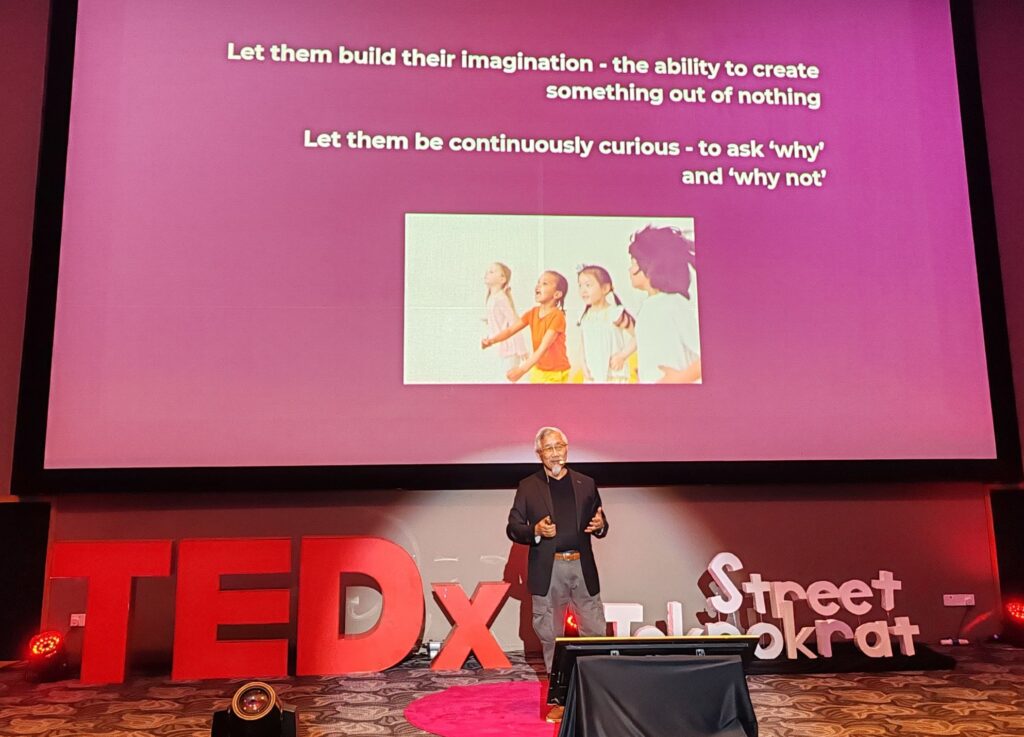
TedxTalk @ MMU: Curiosity Ignites Creativity

HOW CAN WE PREPARE OURSELVES FOR A.I.?Facts are no longer enough. In the age of AI, curiosity is survival. Have you noticed how fast AI is moving? Every week there’s a new course.A new feature.A new headline about jobs changing—or disappearing. Sometimes it feels like every other day. So… Can we ever catch up? Some think it’s a bubble. That it will burst. Unlikely. The big players chasing AGI may or may not get there. But “narrow AI”- the kind built into everyday tools – will keep spreading.Translators. Navigation apps. Image recognition. Office tools.Quietly reshaping how we live and work. So how do we prepare? If you’re just a user, you’re already covered.AI is running behind the scenes – optimising your food delivery or suggesting edits in your documents. But if you want to create value?To stay relevant?You need more. You need curiosity. The kind that asks: could this be done differently? could this be done better? And when it comes to the next generation… curiosity alone won’t be enough. As I shared at TEDx on 13 September 2025, Multimedia University: AI will change the world faster than any education system can keep up. We can’t hand the next generation all the answers – AI will always have more answers. But we can give them the ability to ask better questions. We need schools to change. Not just teaching kids to cram for exams. But to: Spark imagination – the power to create something from nothing. Feed curiosity – the courage to ask “what if?” and “why not?” CURIOSITY is the spark. CREATIVITY is the fuel. The future won’t belong to those who memorise the most facts. It will belong to those who can IMAGINE what doesn’t yet exist. Let’s raise children not just to use AI.But to out-think it. Because the next generation won’t just cope with the future.They’ll shape it.

TedxTalk @ MMU: Curiosity Ignites Creativity Read More »

How can Malaysia keep up with rapid technology advances?

The topic was: “THE FUTURE OF TECH ADVANCES OVER THE NEXT DECADE”.  Of course, the answer was going to be A.I. AI is evolving almost every week. As a result, AI is driving everything else: 🌀 Semiconductors.🔹 Advanced Packaging.💠 Data Centers.🌊 Power and Water requirements. ☀️ Sustainability.🏤 What our offices will look like (less people).🤼 How we work (faster). So, “HOW CAN WE KEEP UP WITH THE RAPID TECH ADVANCES?” The moderator asked the panel at MBOT’s ENTICE 2025 event this week. My answer: BE CURIOUS 🤔 Be curious about new announcements. About old ways.About how to use new tools; how to improve your work. That’s the starting point. Then go explore. Learn. As I said at the panel: “YOU DO NOT NEED TO GO TO UNIVERSITY TO GAIN KNOWLEDGE ANY MORE.” Everything is now available from the internet. Or from AI. If you know how to ask questions. Of course, formal learning is the fastest way to get foundational knowledge of any subject. But AI is moving faster than any educational system can respond. Start-ups in Silicon Valley have long ago not required you to have a university degree to join them. They just need your brains. And skills. They find talent wherever they can. 🟢 To develop a product.🔵 To build their business.🟠 To innovate. Large corporations are beginning to realise this.A certificate does not guarantee you can do any of that. CURIOSITY does. People who are curious, and then ACT.Ask questions.Look for answers. Malaysian companies need to realise this.You need curious staff to innovate.  Not just engineers with degrees.You also need managers who know how to respond and nurture innovation. I related an example of our RFID highway toll system. The idea is good. But the implementation is unreliable. How many of us had to reverse our cars at the toll gate because it could not detect our RFID tag? Many hands shot up. 🙋‍♂️ 🙋 🙅 The company has not yet shown any curiosity (or interest) to find out and fix it. How can our companies be able to show face and say our products are “Made By Malaysia”? Malu-lah. I said. By 2030, ASEAN is forecast to be the 3rd largest populated region in the world – after India and China. Expected to exceed 700 million. More than Europe. And Malaysia is smack in the right position to leverage this. If only our companies know how to do this. With the right talent. At all levels. And the mindset to Cooperate. Collaborate. And Combine expertise. With universities. With other companies. Countries.Perhaps even with their competitors. The world is our oyster.  Starting with ASEAN. Thank you to President Siti Hamisah Tapsir and Malaysia Board of Technologists for inviting me to celebrate their 10th Anniversary event. And meeting so many others there, too numerous to mention here.

How can Malaysia keep up with rapid technology advances? Read More »

Panel Discussion: Intelligent Manufacturing KL 2025

What an inspiring panel discussion @Intelligent Manufacturing KL!  We all know leadership is critical in talent development – but after moderating this panel, I realized there’s someone even more important: you. Yes, YOU. While organizations play a role, your growth – your talent development – is ultimately your responsibility. This hit home after witnessing another powerful discussion in Penang recently, brilliantly articulated by Masliza Mansor. [read it here https://lnkd.in/g_HPUEpf] It is universally recognised that we are now finding it harder to get talent, not just good talent. The reasons: 1️⃣ The world is changing faster than ever. 2️⃣ Talent isn’t just scarce – it’s evolving. Companies everywhere are struggling to attract and retain their best people. Why? Three seismic shifts: ⚡TECHNOLOGY: AI, automation, and robotics aren’t just tools – they’re redefining what it means to be competitive. ⚡GEO-POLITICS: New alliances, tariffs, and trade dynamics force businesses to adapt just to stay competitive. ⚡WORKFORCE EXPECTATIONS: Gen Z and Alpha aren’t just looking for jobs – they’re demanding purpose, culture, and growth. A good salary? That’s just a start. BIG NAME companies – especially well-known multinationals – can easily get the best talent. Every graduate has heard of them, their successes.  And of course, their salaries. MNCs have long leveraged their reputation to attract top talent. So what’s the answer? COMPANIES need to let potential employees know what the company – especially local ones – represent.  What the company does, what’s the company culture, and (then) how their salaries are competitive. Don’t just rely on AI. Or your marketing department – that’s to reach out to customers about your products. You want to attract talent to work for you. Use human intelligence – listen, inspire, and create workplaces where people feel valued. Culture, vision, and growth opportunities matter more than ever. FOR INDIVIDUALS: The panel flipped the script. YOU are your own leader. YOUR  communication, curiosity, and adaptability determine your success, your next job. 👍 Speak up with clarity and respect.👍 Keep learning – the world won’t wait for you.👍 Own your development like your career depends on it (because it does). The best talent isn’t just found – it’s built. IT STARTS WITH YOU. Intelligent manufacturing isn’t just about machines – it’s about people. Thank you to the incredible panelists SookLing Teh, Jaszmine K.B., Oscar Low, WANG Xin, Pratibha Kurnool.  What an enlightening discussion. A big thank you also to Fiona Chiew for the invitation to Intelligent Manufacturing – IMKL Let’s bring this conversation to Penang next!

Panel Discussion: Intelligent Manufacturing KL 2025 Read More »