October 2025

Podcast with Salah Nasri, International Semiconductor Industry Group

Thank you Salah Nasri for organizing this podcast! Photo: Ellen Wendelin Loh, ET Tan & Salah Nasri What makes a risky tech bet pay off? Here’s the formula. In this Semiconductor Leadership Podcast episode, ET Tan — former HP & Seagate Technology leader and a pioneer in R&D — breaks down the difference between bold innovation and costly missteps: Start with insight — deeply understand the real market need. Engineer precisely — combine tech elements to deliver what the market craves:Faster. Smaller. Cheaper. Whether you’re building next-gen chips or launching a startup, ET’s advice cuts through the noise:→ Don’t chase trends. Solve pain points.→ Innovation wins when it meets urgency with clarity.→ Tech is a tool — leadership is the multiplier. Full episode highlights:• The million-transistor breakthrough at HP• Why UK & US innovation cultures differ — and what Penang can learn• How Malaysia can lead in the next global semiconductor wave  Listen now and get a masterclass in product-market fit, leadership, and turning vision into velocity.  Link to original article.

Podcast with Salah Nasri, International Semiconductor Industry Group Read More »

It takes a village to raise a child

We already know what works in education – the question is, will the whole village get involved?“IT TAKES A VILLAGE TO RAISE – and educate – A CHILD.” That was the theme of a recent discussion I joined at the Khazanah Research Institute with a distinguished panel of educationists, moderated by the acclaimed Imran Ahmad. What a privilege! The proverb reminds us that you cannot depend on parents alone – or government alone – to raise a child. You need the whole community. Education already receives the largest share of Malaysia’s national budget. About 20%, or RM85 billion in 2026. So why do we still hear the familiar complaint that “the government isn’t doing enough for education”? I’ve lived and worked in the UK, the US, Malaysia – and yes, even Singapore – and heard the same thing everywhere. Even in Finland, often seen as the world’s best education system, people there still debate what’s wrong. Our panel listed many issues that sound familiar: 🤷‍♂️ Falling standards and teacher training gaps🤦‍♂️ Bullying, ethics and character development🙏 Too much central control, too little school empowerment🙅 The STEM vs TVET divide🙋‍♂️ Widening social gaps🤔 Lack of parental involvement But we also have bright spots worth recognising: 👍 Malaysian graduates and professionals thriving globally👌 Private institutions gaining international recognition💪 Local universities attracting overseas students The panel concluded that we already know what works: ✅ Start early – children who begin learning at 4 or 5 have a real head start✅ View TVET as part of STEM – both need a base in science and maths✅ Build leadership and values early – through capable, inspired teachers ✅ And the successful “Trust Schools” pilot funded by Khazanah – 10 schools in Johor and Sarawak, with over RM300 million invested – showing that collaboration and accountability can transform learning outcomes. But not deployed. Here’s the key insight:These lessons don’t belong to the government alone – they belong to all of us, the whole village. There must be open sharing of learnings and trust between govt and the public. Only when both sides listen and learn from each other can lasting change happen. The “village” includes every voice – parents, professionals, raykat, and yes, everyone here on hashtag#LinkedIn. We can’t just complain about what’s wrong. We need to talk more about what we want to see more of – the values, curiosity, and character we hope the next generation will carry. Because when the village speaks – consistently and collectively – the system starts to listen. If we want our public schools to thrive again, the village must care for all its children – NOT JUST OUR OWN. Maybe it’s time we stop outsourcing the village. What do you think? Thank you, Dr Mohamed Yunus Yasin, for the invitation and for organising this discussion.

It takes a village to raise a child Read More »

47th ASEAN Summit, 27-28 October 2025, Kuala Lumpur

In case you haven’t heard, US President TRUMP WILL BE VISITING MALAYSIA FOR THE 47th ASEAN SUMMIT, alongside the Heads of State of Brazil, South Africa, India, and Canada.And yes, even President Putin might attend. It’s a BIG MOMENT for Malaysia 🇲🇾 All 10 ASEAN leaders will be here, joined by Timor-Leste, our member-in-waiting. The gathering reflects ASEAN’s growing role as a stabilising force and economic powerhouse in a world that’s becoming increasingly multi-polar. Amid global tensions, ASEAN has remained a Zone of Peace, Freedom and Neutrality (ZOPFAN) – a vision declared in 1971 to keep Southeast Asia free from external interference. This was later strengthened in 2003 through the Bali Concord II, which marked a shift from strict neutrality toward an ASEAN Community of deeper economic and institutional integration. The theme for the 2025 Kuala Lumpur ASEAN Summit “Inclusive, Resilient, Sustainable ASEAN” means: 💪 Ensuring youth, women, MSMEs, and rural communities are not left behind💪 Making sustainability about long-term resilience, not just slogans💪 Supporting the smaller and less-developed ASEAN states With this as the backdrop, a small select group was convened to a closed-door Roundtable to discuss, comment, and make suggestions on many of the sensitive issues on tariffs, trade and technology that may be brought to the Summit. And of course, about what POTUS may bring up. What an honour to be invited. And to contribute perspectives shaped by years of working across technology, policy, and human development in the region and elsewhere around the world. ASEAN’s future will be written right here in Kuala Lumpur, KLCC on 26-28 October. It’s a privilege to play a small part in preparing PMX for this momentous meeting. (No, nothing discussed will be revealed here.) What does it mean to local businesses and the general public except for the road closures during the summit? 😉 Watch this space for future posts. 🙏 Terima Kasih to Khazanah Nasional Berhad, Khazanah Research Institute, Asian Strategy & Leadership Institute, and the Prime Minister’s Office for the invitation.

47th ASEAN Summit, 27-28 October 2025, Kuala Lumpur Read More »

Learning the HP way in my first job

MY FIRST JOB WASN’T JUST ABOUT LEARNING TO BE AN ENGINEER – I also learnt how to be human at work. I had just graduated from Imperial College in 1980 and joined HP’s Telecoms Division at South Queensferry in Scotland – a small, dreary town by the Firth of Forth. As a group of young graduates, we were all put through an apprentice program that included “The HP Way”. This wasn’t your usual corporate onboarding – it was a complete philosophy of how to live, work, and lead. Around that same time, the book ‘In Search of Excellence’ came out – and HP was held up as one of the most admired and innovative companies in the world. Wow! For those of us who had just joined, that made us proud. We knew we had made the right decision. More importantly, it taught us that doing things the right way matters.These were the principles that defined Silicon Valley and became the DNA of icons like Intel Corporation, Apple, and Google. ~~ 🌿 The HP Way was built around five simple principles: 1️⃣ PROFIT is not the goal – it’s the result of doing the right things well.HP’s founders, Bill Hewlett and Dave Packard, believed the real purpose of business was to make a contribution. Focus on excellence, and profit would follow. 2️⃣ CUSTOMERS come first.We were taught to listen – to understand the customer’s problem deeply before offering a solution. It wasn’t just service. It was respect. 3️⃣ FIELD OF INTEREST – do only what you can do best.HP avoided chasing fads. That discipline allowed engineers to master their craft instead of running after every shiny trend. 4️⃣ GROWTH through opportunity, not just size.Growth meant creating space for people to learn, invent, and lead – not just expanding headcount or revenue for its own sake. 5️⃣ RESPECT for individuals.Everyone, from technician to VP, was treated with dignity. We had a culture called MBWA – “Management by Walking Around.”Managers didn’t hide in offices. They walked the floor, listened, and asked questions. They ‘turun padang’. When I moved to HP Labs in Palo Alto, those values still guided everything – from research to management. I practiced it myself. There, scientists and researchers were empowered to work with freedom and trust – the culture assumed you wanted to do the right thing. When Carly Fiorina became CEO in 1999, everything changed. 🔶 Targets replaced trust.🔶 Revenue replaced respect.🔶 Purpose became valuation and stock price. Within a year, many of us left – not because we stopped believing in HP, but because HP had stopped believing in The HP Way. ~~ I will always cherish those 20 years. They taught me how to manage people, technology, and business – the right way. Now, whenever I find a culture that values integrity, contribution, and respect, I try to practice a little of that HP Way again. And try to pass it on.

Learning the HP way in my first job Read More »

Small local brands vs big international players

How can small local brands compete against big international players? I recently bought a gas stovetop at Ban Hin Bee Sdn Bhd, an otai Penang electrical goods store that’s been around since 1961. After my transaction was completed, the store manager said, “Ms Wong, after this I will invite you to be our VIP member.” I stared at her in surprise. Wow, VIP? The item I bought wasn’t even that expensive. Before I could press her for benefits a VIP member was entitled to, the manager gave me another piece of good news. Apparently for every purchase above RM600, I qualified for a lucky draw. My prize was a RM20 Touch ’n Go top-up. Not bad! Just when I thought the surprises were over… “Ms Wong, let’s take a photo together,” she invited. “Why?” I asked, suspicious. “For our social media pages,” she explained. I hesitated. Until she threw in this persuasive line: “Ms Wong, you are a pretty lady, will sure look nice. Come lah.” How to say no? After we reached home, I’d forgotten all about the incident until a WhatsApp from an unknown number popped up that evening: “Thank you so much for your recent purchase with us! We truly appreciate your support and trust in our products. I hope everything went smoothly during delivery and that you’re satisfied with your new appliances. If there’s anything at all that we can assist you with, please don’t hesitate to reach out.” Attached was a scanned copy of my invoice and a photo with the dynamic sales manager Shirnee. Colour me impressed! This is how an otai brand can win leverage against big international players with their shiny showrooms, bottomless marketing budgets, and strategic mall locations. Personalisation and digitization. Ban Hin Bee used tech (WhatsApp) to stay connected, and paired it with human warmth (direct message, personal touch). I couldn’t help comparing this with a recent experience at an international retailer in a mall. The salespeople huddled among themselves, I had to flag for attention, and once I paid, I felt like another faceless entry in their sales ledger. By contrast, Shirnee attended to me seconds after I walked in, answered my questions patiently, never once pushed, and yes, made me feel like a VIP. 👉 To win in a crowded marketplace, you don’t have to go toe to toe with your competitors. Play to your strengths. That’s how you stand out. Now, excuse me while I check if my photo made it onto their socials.

Small local brands vs big international players Read More »

Move over LLM. Here comes SLM

LLMs ARE OVERRATED. FACTORIES NEED SLMs INSTEAD! When people hear “AI in manufacturing,” they think of massive LLMs, complicated deployments, and costs that only Big Tech can afford. But let’s start closer with something familiar. Take defect detection in your test and QA process. Every factory already collects huge amounts of data: Defect logs, yield reports, FA images. Collected. Collated. Categorised. The problem isn’t data. The problem is: 🌀 Too much of it (really hard to analyse to extract trends & patterns) 🌀 All static (we usually look only after issues happen) This is where AI comes in. SLMs, not LLMs. With simple data science: data analysis, data engineering, data visualisation. In other words, focused machine learning (ML) and developing models that: ✅ Spot anomalies in your test data before they happen ✅ Flag subtle trends and shifts in distributions that SPC charts might miss ✅ Correlate defect patterns across machines, lots, or even suppliers None of this requires massive hardware – or a billion dollar AI system. Most factories already have 80% of what’s needed: 👍 Historical test data (structured + unstructured) 👌 IT systems that store all this data 👨‍💻 Engineers who know the failure modes inside out What’s missing is probably just an additional layer: 👨‍🔬 Data analysts/engineers who can clean and prepare the data 🎉 Simple ML models trained to recognize patterns faster than the human eye Don’t know where to start? Here’s a high-level recipe: 1️⃣ PICK ONE AREA Start small. Defect detection is perfect because data is already available. 2️⃣ GATHER AND CLEAN THE DATA Consolidate your test logs, FA databases, and images. Focus on consistency. 3️⃣ APPLY THE RIGHT TOOL Use lightweight ML models (suggest open sources) to flag unusual patterns. 4️⃣ VALIDATE WITH EXPERTS The engineers need to confirm whether the AI’s flagged defects are real. 5️⃣ DEPLOY IN PARALLEL Run the model alongside your existing QA processes. Build confidence first before replacing anything. 6️⃣ SCALE GRADUALLY Once it works for one test stage, extend to others. Or move on to more sophisticated models – like predictive maintenance, process drift detection, or optimizing test times. ~~ The key point is: you don’t need to “import” AI into the factory. You already have it in the data. These models are just tools to unlock what’s been sitting around for years. AI in production isn’t about replacing people. It’s about giving engineers and managers sharper tools to anticipate problems, react faster, and prevent them before they happen. The question isn’t whether you can afford AI. The question is whether you can afford NOT to have AI on your shop floor. ~~ Need help getting started? Or more pointers? Get in touch. Start small, validate fast, and you’ll wonder why you didn’t begin sooner.

Move over LLM. Here comes SLM Read More »

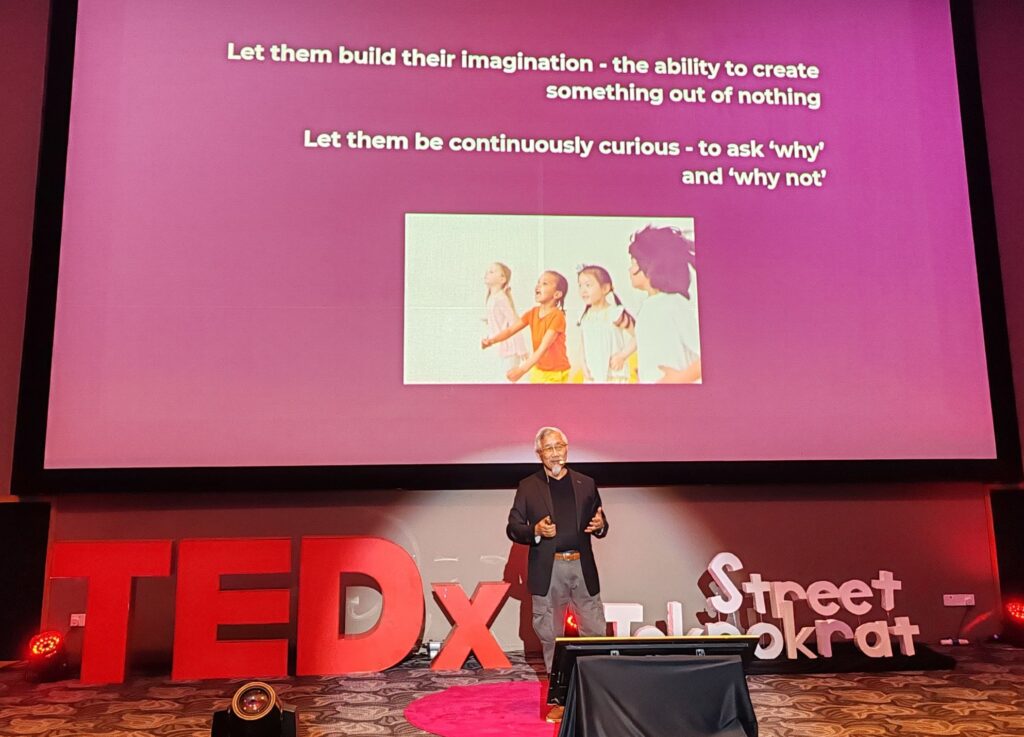
TedxTalk @ MMU: Curiosity Ignites Creativity

HOW CAN WE PREPARE OURSELVES FOR A.I.?Facts are no longer enough. In the age of AI, curiosity is survival. Have you noticed how fast AI is moving? Every week there’s a new course.A new feature.A new headline about jobs changing—or disappearing. Sometimes it feels like every other day. So… Can we ever catch up? Some think it’s a bubble. That it will burst. Unlikely. The big players chasing AGI may or may not get there. But “narrow AI”- the kind built into everyday tools – will keep spreading.Translators. Navigation apps. Image recognition. Office tools.Quietly reshaping how we live and work. So how do we prepare? If you’re just a user, you’re already covered.AI is running behind the scenes – optimising your food delivery or suggesting edits in your documents. But if you want to create value?To stay relevant?You need more. You need curiosity. The kind that asks: could this be done differently? could this be done better? And when it comes to the next generation… curiosity alone won’t be enough. As I shared at TEDx on 13 September 2025, Multimedia University: AI will change the world faster than any education system can keep up. We can’t hand the next generation all the answers – AI will always have more answers. But we can give them the ability to ask better questions. We need schools to change. Not just teaching kids to cram for exams. But to: Spark imagination – the power to create something from nothing. Feed curiosity – the courage to ask “what if?” and “why not?” CURIOSITY is the spark. CREATIVITY is the fuel. The future won’t belong to those who memorise the most facts. It will belong to those who can IMAGINE what doesn’t yet exist. Let’s raise children not just to use AI.But to out-think it. Because the next generation won’t just cope with the future.They’ll shape it.

TedxTalk @ MMU: Curiosity Ignites Creativity Read More »

How can Malaysia keep up with rapid technology advances?

The topic was: “THE FUTURE OF TECH ADVANCES OVER THE NEXT DECADE”.  Of course, the answer was going to be A.I. AI is evolving almost every week. As a result, AI is driving everything else: 🌀 Semiconductors.🔹 Advanced Packaging.💠 Data Centers.🌊 Power and Water requirements. ☀️ Sustainability.🏤 What our offices will look like (less people).🤼 How we work (faster). So, “HOW CAN WE KEEP UP WITH THE RAPID TECH ADVANCES?” The moderator asked the panel at MBOT’s ENTICE 2025 event this week. My answer: BE CURIOUS 🤔 Be curious about new announcements. About old ways.About how to use new tools; how to improve your work. That’s the starting point. Then go explore. Learn. As I said at the panel: “YOU DO NOT NEED TO GO TO UNIVERSITY TO GAIN KNOWLEDGE ANY MORE.” Everything is now available from the internet. Or from AI. If you know how to ask questions. Of course, formal learning is the fastest way to get foundational knowledge of any subject. But AI is moving faster than any educational system can respond. Start-ups in Silicon Valley have long ago not required you to have a university degree to join them. They just need your brains. And skills. They find talent wherever they can. 🟢 To develop a product.🔵 To build their business.🟠 To innovate. Large corporations are beginning to realise this.A certificate does not guarantee you can do any of that. CURIOSITY does. People who are curious, and then ACT.Ask questions.Look for answers. Malaysian companies need to realise this.You need curious staff to innovate.  Not just engineers with degrees.You also need managers who know how to respond and nurture innovation. I related an example of our RFID highway toll system. The idea is good. But the implementation is unreliable. How many of us had to reverse our cars at the toll gate because it could not detect our RFID tag? Many hands shot up. 🙋‍♂️ 🙋 🙅 The company has not yet shown any curiosity (or interest) to find out and fix it. How can our companies be able to show face and say our products are “Made By Malaysia”? Malu-lah. I said. By 2030, ASEAN is forecast to be the 3rd largest populated region in the world – after India and China. Expected to exceed 700 million. More than Europe. And Malaysia is smack in the right position to leverage this. If only our companies know how to do this. With the right talent. At all levels. And the mindset to Cooperate. Collaborate. And Combine expertise. With universities. With other companies. Countries.Perhaps even with their competitors. The world is our oyster.  Starting with ASEAN. Thank you to President Siti Hamisah Tapsir and Malaysia Board of Technologists for inviting me to celebrate their 10th Anniversary event. And meeting so many others there, too numerous to mention here.

How can Malaysia keep up with rapid technology advances? Read More »